When AI fits
Choosing AI is a decision I make per problem, not a default. A use case has to pass four checks. Most don't, and that's fine.
- Repeats every day. High volume, same shape. A one-off doesn't pay for a model.
- Can be automated. The steps are known and a system can act on them, not just suggest.
- Messy input. Calls, emails, PDFs, photos. Unstructured data is where AI earns its place over rules.
- Worth it to both sides. The user gets time back and the business gets something it can price and measure.
And humans keep what they should. I design the handoff to people on day one, at the boundary the customer draws. AI does the repeat work; people make the calls that need judgement.
Where the roadmap came from
Out of 80 discovery calls in four months, two choke points showed up everywhere: getting a request into the system, and getting an invoice approved. That set the roadmap. Helpdesk AI first, Payment Validator next.
How many of 16 enterprise accounts raised each problem
One call, start to finish: how I find the problem
A hospital estate came to us asking for a switchboard fix. Three people joined the discovery calls. This is how I broke down what they said, picked one problem and set the pilot. People are shown by role.
1. Who was in the room
Deputy Director of Estates
Came for switchboard automation. Wanted resource forecasting and live SLA reports, then handed over to operations.
My kind of role in this is almost done.
Would pick: forecasting and reporting
Head of Operations
You're just assigning blindly really to engineers.
Once a job has been closed by an engineer it kind of just disappears.
Would pick: dispatch
Operations lead
It was closed at 3 o'clock. I look on the BMS and it's still not running… If this solution doesn't fix that, there's no point in me having it.
Would pick: closing the loop
2. Everything we heard: 24 problems
Closing the loop Picked
- I3Nothing visible between "assigned" and "closed"
- I4Closed doesn't mean fixed
- I5The person who asked is never kept informed
- S4Tracking finished jobs is tedious
- S5Remedial work vanishes after a planned visit
Intake
- I1Requests arrive vague: "Chemo too hot"
- I2No room, location, issue type or photo
- I6Duplicate tickets across two teams
Out of hours
- G3Out-of-hours dead zone
- G4Night phone jobs typed in next day
- G5Switchboard automation
Dispatch
- S1No live view of who is available
- S2Jobs assigned by hand from a backlog
- S3No idea how long a job will take
- S6Priority lives in people's heads
- S7In-house or subcontractor, picked from memory
- I9Travel wasted, visits not bundled
- I10Hidden limits, like who doesn't drive
Field capture
- I7Soft services not digitised
- I8Defects seen on walk-arounds go unlogged
- I11A photo instead of a checklist at completion
Reporting and cost
- G1Resource forecasting
- G2No live SLA and KPI reports
- I12Charging engineer time between two organisations
3. What we picked, and why
| Problem | Decision | Why |
|---|---|---|
| Closing the loop | Pilot, top priority | Two people raised the same root cause on their own: a fan marked fixed that wasn't, and remedial work that vanished. It was also the operations lead's pass or fail test. |
| Intake | In, as support | It feeds the loop. On its own, 10 tickets a week is too few to prove anything. |
| Out of hours | In, for free | An email agent answers around the clock anyway. The switchboard stays out. |
| Field capture | In | It came in once WhatsApp became a day-one channel. |
| Dispatch | Not now | The pilot site is about 1% of dispatch volume, the availability data isn't in any system, and it would change how all 22 engineers work. |
| Reporting and cost | Not now | It only makes sense at full-estate scale. |
Success signal: every closed job carries a reason and a fix type, 100% of the time. Prove it at about 10 tickets a week, then roll out to 20,000 reactive and 100,000 planned jobs a year.
How I run my own week
PMOS is the operating system I built for myself. Every request lands as a task, every call I make is logged as a decision with its why, and anything meant to change a customer's behaviour is tracked as a bet, with a before number and an after number.
The bets keep me honest. Before Payment Validator is allowed to reject invoices on its own, the customer and I agree the highest false-rejection rate we'll accept. In watch-only mode the AI was wrong on about 1% of invoices. If live rejections go above the agreed line, the system drops back to watch-only. The line is set before the switch, not after.
- Tasks
- 500+ logged since May 2026
- Decisions
- Each with why, outcome and who was in the room
- Bets
- One customer behaviour change each, measured before and after
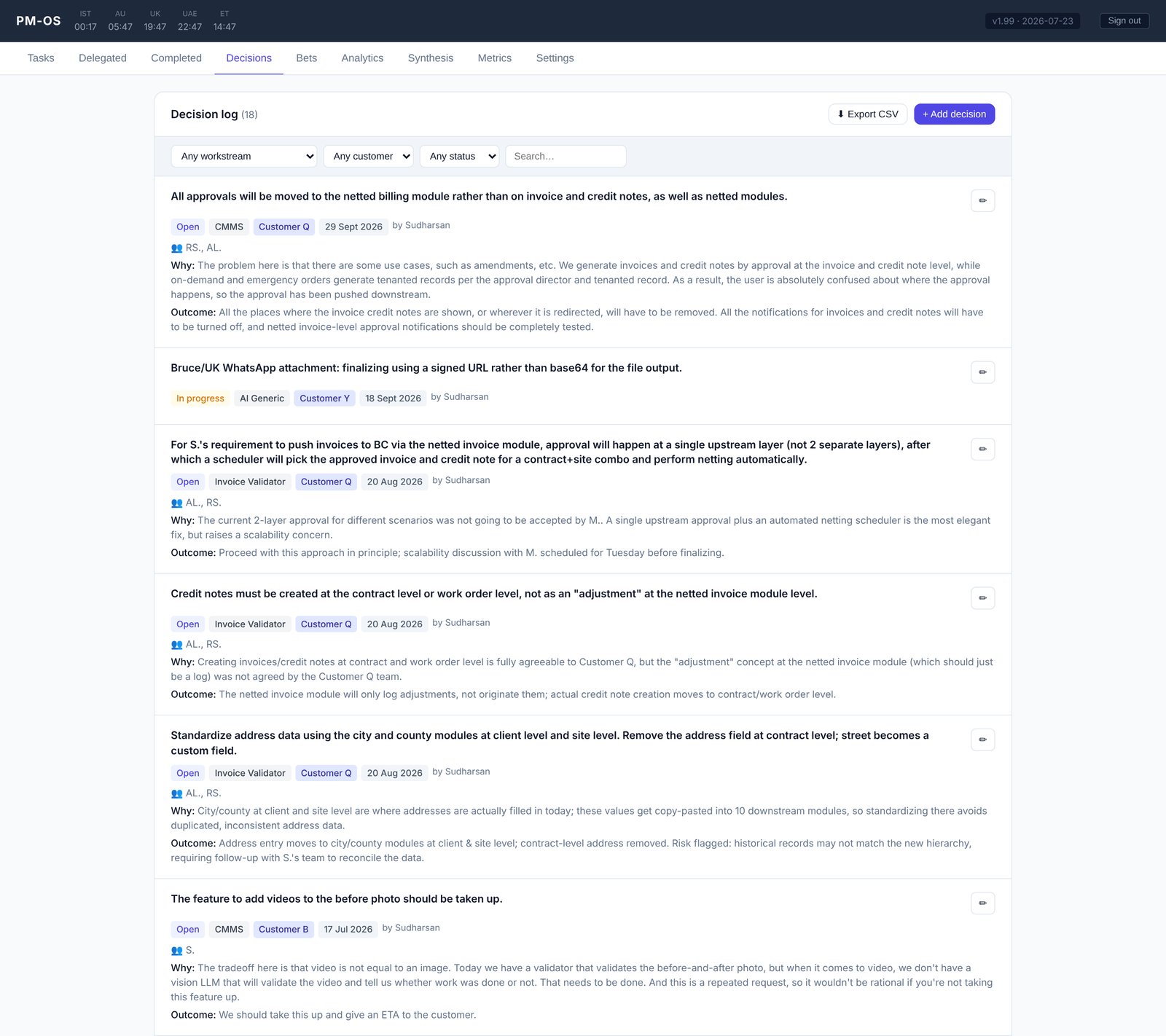
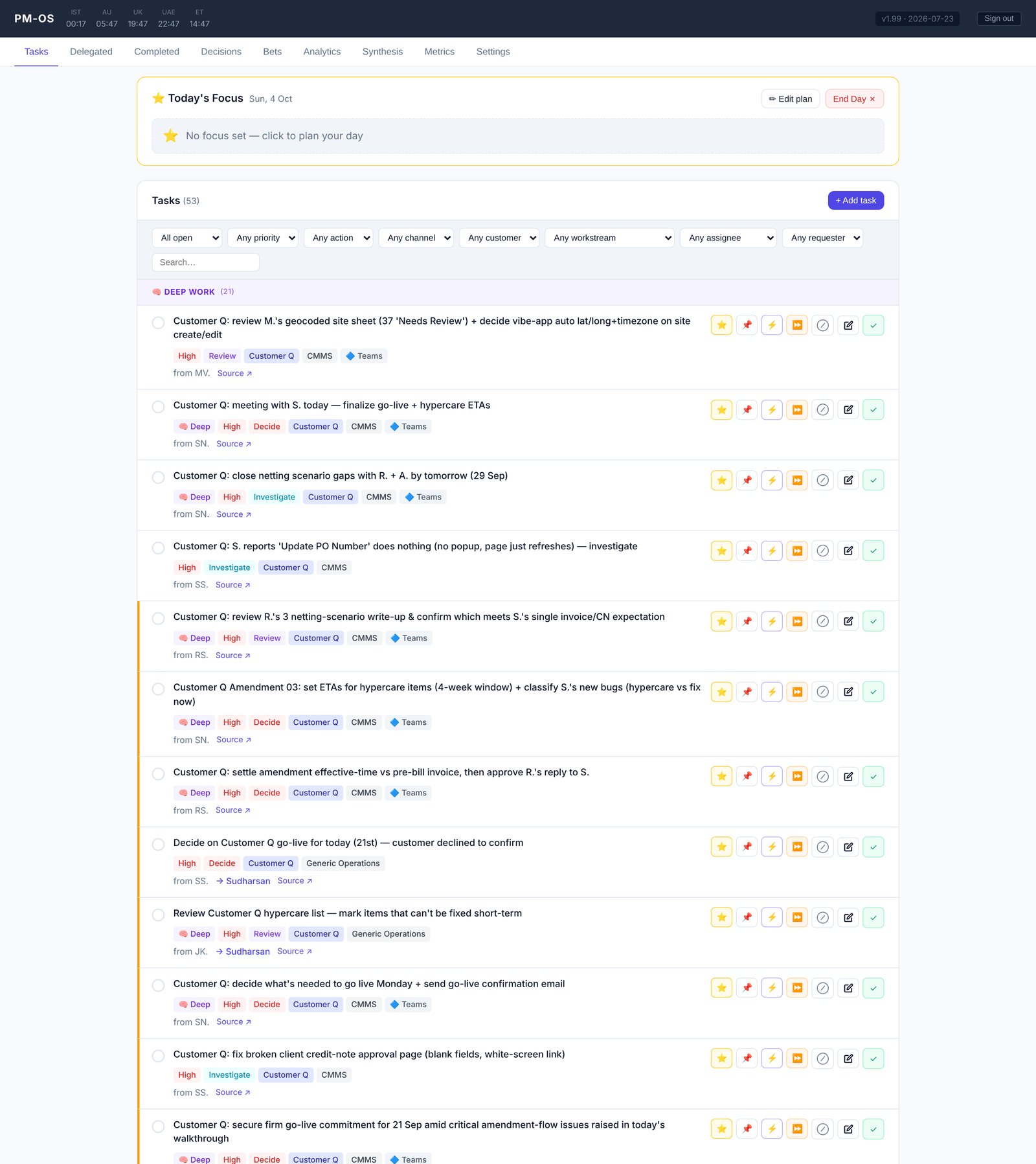
Customers appear as letters and people as initials. Commercial terms are left out.